Maximize 2026 Social Security: Your Essential Benefit Guide

Anúncios
Unlocking Your Full Potential: How to Maximize Social Security 2026 Benefits
Planning for retirement is one of the most critical financial endeavors an individual will undertake. For many, Social Security benefits form the bedrock of their retirement income, providing a stable and predictable source of funds. As we look ahead to 2026, understanding the intricacies of the Social Security system and implementing strategic planning can significantly impact the amount you receive. This comprehensive guide is designed to help you maximize Social Security 2026 benefits, ensuring you make informed decisions that secure your financial future.
Anúncios
The Social Security Administration (SSA) continuously adapts its policies and calculations, making it essential to stay updated on potential changes and how they might affect your retirement planning. While the core principles of Social Security remain steadfast, nuances in eligibility, claiming ages, and benefit calculations can lead to substantial differences in your monthly payout. Our goal here is to demystify these complexities and provide actionable strategies to help you navigate the system effectively and maximize Social Security 2026 benefits.
Whether you are years away from retirement, or nearing the age to claim, understanding the factors that influence your benefits is paramount. This article will delve into eligibility requirements, the impact of claiming age, strategies for spousal and survivor benefits, the role of earnings records, and how to account for taxes and other deductions. By the end of this guide, you will be equipped with the knowledge to make strategic choices that could significantly enhance your retirement security.
Anúncios
Understanding Social Security Basics for 2026
Before diving into maximization strategies, it’s crucial to grasp the fundamental concepts of Social Security. Your benefits are primarily based on your lifetime earnings. The SSA calculates your Average Indexed Monthly Earnings (AIME) using your 35 highest-earning years. If you have fewer than 35 years of earnings, zeros will be factored into the calculation, which can reduce your AIME. This AIME is then used to determine your Primary Insurance Amount (PIA), which is the benefit you would receive if you claim at your Full Retirement Age (FRA).
What is Full Retirement Age (FRA)?
Your Full Retirement Age (FRA) is a crucial determinant in Social Security calculations. It’s the age at which you are entitled to receive 100% of your PIA. FRA depends on your birth year:
- Born 1943-1954: FRA is 66
- Born 1955: FRA is 66 and 2 months
- Born 1956: FRA is 66 and 4 months
- Born 1957: FRA is 66 and 6 months
- Born 1958: FRA is 66 and 8 months
- Born 1959: FRA is 66 and 10 months
- Born 1960 or later: FRA is 67
Knowing your FRA is the first step in understanding how early or late claiming affects your benefits and how to maximize Social Security 2026 payouts. Claiming before your FRA results in a permanent reduction of benefits, while delaying past your FRA can lead to increased benefits.
Credits and Eligibility
To qualify for Social Security retirement benefits, you generally need to earn 40 credits. You can earn up to 4 credits each year. In 2024, you earn one credit for every $1,730 in earnings, and this amount typically increases annually. For 2026, this threshold will likely be slightly higher. This means you need to work for at least 10 years (earning the maximum 4 credits per year) to be eligible for benefits. It’s important to regularly check your Social Security statement to ensure your earnings record is accurate and that you are on track to meet the credit requirements.
The Impact of Claiming Age: When to Start Benefits
One of the most significant decisions you’ll make regarding Social Security is when to start claiming your benefits. This choice can have a profound and permanent impact on your monthly income throughout retirement. Understanding the trade-offs between early, full, and delayed claiming is fundamental to maximizing your benefits.
Claiming Early (Age 62)
You can begin receiving Social Security retirement benefits as early as age 62. However, claiming at this age results in a permanent reduction of your monthly benefit. The reduction is approximately 5/9 of 1% for each month before your FRA, up to 36 months. If you claim more than 36 months early, the reduction is 5/12 of 1% per month. For someone with an FRA of 67, claiming at 62 could result in a benefit reduction of up to 30%. While this provides income sooner, it significantly reduces your lifetime payout if you live a long life. This strategy might be suitable for those with health issues, other substantial retirement income sources, or those who genuinely need the funds immediately.
Claiming at Full Retirement Age (FRA)
Claiming at your FRA means you receive 100% of your Primary Insurance Amount (PIA). This is the benchmark against which early and delayed claiming are measured. For many, claiming at FRA strikes a balance between receiving benefits sooner and receiving a higher monthly amount. It’s a conservative approach that guarantees your full earned benefit without reduction or the need to wait longer.
Delaying Benefits (Up to Age 70)
This is often the most powerful strategy to maximize Social Security 2026 benefits. For each month you delay claiming past your FRA, up to age 70, you earn Delayed Retirement Credits (DRCs). These credits increase your monthly benefit by 2/3 of 1% per month, or 8% per year. This means that if your FRA is 67 and you delay until age 70, your monthly benefit will be 124% of your PIA. After age 70, there are no additional credits to be earned, so there’s no financial advantage to delaying beyond that point.
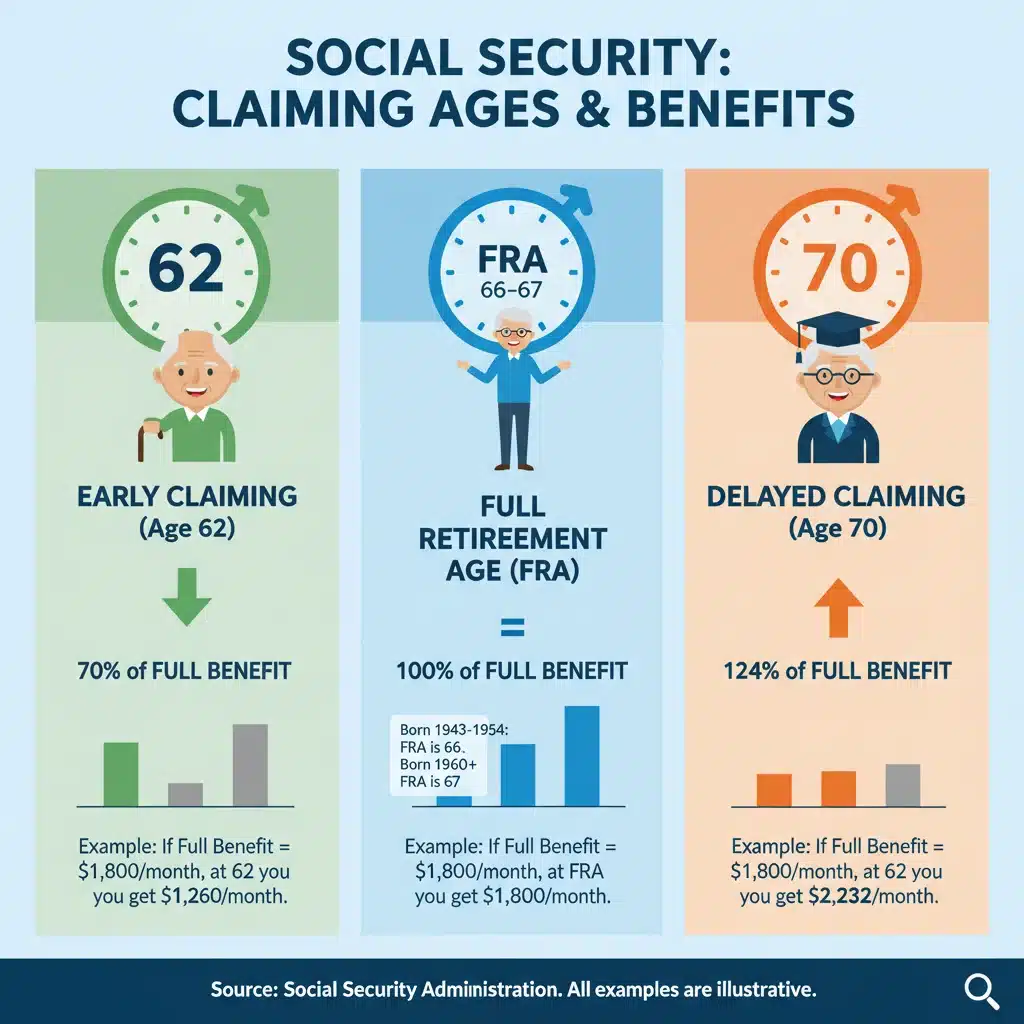
The decision to delay can be particularly beneficial for individuals with good health and a family history of longevity, or those who have other income sources to support them until age 70. The 8% annual increase is a guaranteed, inflation-adjusted return that is difficult to match in other investments.
Strategies to Maximize Social Security 2026 Benefits
Beyond the claiming age, several other strategies can help you get the most out of your Social Security benefits. These often involve coordinating with a spouse, understanding how work affects benefits, and being aware of other government benefits.
Spousal and Survivor Benefits
If you are married, divorced, or widowed, you may be eligible for benefits based on your spouse’s or ex-spouse’s work record, which can be a significant way to maximize Social Security 2026 for your household. These benefits generally do not reduce your spouse’s benefit.
- Spousal Benefits: A spouse can claim up to 50% of their partner’s PIA. To claim spousal benefits, your spouse must have already filed for their own benefits. You must be at least 62 or caring for a child under 16 or disabled. If you claim spousal benefits before your FRA, they will be reduced. If you are eligible for both your own benefit and a spousal benefit, the SSA will pay your own benefit first. If the spousal benefit is higher, you’ll receive an additional amount to bring you up to the spousal benefit level.
- Survivor Benefits: If your spouse passes away, you may be eligible for survivor benefits. A widow or widower can receive 100% of the deceased spouse’s benefit if they claim at their own FRA. Benefits can be claimed as early as age 60 (or age 50 if disabled), but they will be reduced. There are also benefits for children and dependent parents.
- Divorced Spousal Benefits: If you were married for at least 10 years and are now divorced, you may be able to claim benefits on your ex-spouse’s record, provided you are currently unmarried and at least 62 years old. Your ex-spouse does not need to have filed for their benefits, as long as they are at least 62 and you’ve been divorced for at least two years. This benefit does not impact your ex-spouse’s benefits or those of their new spouse.
Strategic claiming for couples often involves one spouse (usually the higher earner) delaying benefits to age 70 to maximize their own benefit, which also increases the potential survivor benefit for the other spouse. The lower-earning spouse might claim their own reduced benefit or a spousal benefit earlier, providing income while the higher earner’s benefit grows.
Working While Receiving Benefits
If you continue to work while receiving Social Security benefits before your FRA, your benefits may be reduced. For 2024, if you are under FRA, the SSA deducts $1 from your benefits for every $2 you earn above $22,320. In the year you reach FRA, the SSA deducts $1 from your benefits for every $3 you earn above a different, higher limit ($59,520 in 2024) until the month you reach your FRA. Once you reach your FRA, there are no earnings limits, and you can earn as much as you want without your benefits being reduced.
It’s important to note that any benefits withheld due to the earnings test are not permanently lost. When you reach your FRA, your monthly benefit will be recalculated to account for the months benefits were withheld, effectively increasing your future payments. However, this is a complex area, and careful planning is needed to avoid unexpected reductions, especially if your goal is to maximize Social Security 2026 benefits.
The Importance of Your Earnings Record
Your Social Security benefits are directly tied to your earnings history. The SSA uses your 35 highest-earning years to calculate your benefit. If you have periods of low earnings or no earnings, these years will be counted as zeros, which can lower your overall benefit. One effective strategy to maximize Social Security 2026 is to work longer if you have fewer than 35 years of substantial earnings. Replacing low-earning years with higher-earning years can significantly increase your AIME and, consequently, your PIA.
It is absolutely critical to regularly check your Social Security statement, which you can access online through your My Social Security account. Review your earnings record for accuracy. Errors, such as missing earnings from a past employer, can lead to lower benefits. If you find any discrepancies, contact the SSA immediately to have them corrected.
Navigating Taxes and Cost-of-Living Adjustments (COLAs)
Understanding how taxes affect your Social Security benefits and how COLAs are applied is another key aspect of effective planning to maximize Social Security 2026 benefits.
Taxation of Social Security Benefits
Depending on your combined income, a portion of your Social Security benefits may be subject to federal income tax. Your ‘combined income’ is the sum of your adjusted gross income, any tax-exempt interest, and one-half of your Social Security benefits.
- If your combined income is between $25,000 and $34,000 for an individual, or between $32,000 and $44,000 for a married couple filing jointly, up to 50% of your benefits may be taxable.
- If your combined income is above $34,000 for an individual, or above $44,000 for a married couple filing jointly, up to 85% of your benefits may be taxable.
Some states also tax Social Security benefits, so it’s important to consider your state’s tax laws as well. Strategic financial planning, such as utilizing tax-advantaged retirement accounts (e.g., Roth IRAs) or managing taxable withdrawals, can help mitigate the impact of these taxes and effectively maximize Social Security 2026 benefits by preserving more of your payout.
Cost-of-Living Adjustments (COLAs)
Social Security benefits are adjusted annually based on the Cost-of-Living Adjustment (COLA). This adjustment is designed to help benefits keep pace with inflation. The COLA is announced in October and takes effect in December, impacting benefits paid starting in January of the following year. While the specific COLA for 2026 won’t be known for some time, these adjustments are a vital component of maintaining the purchasing power of your benefits over time. Delaying benefits not only increases your initial payout but also means that the larger initial amount will be subject to future COLAs, leading to even greater cumulative benefits.
Special Considerations for 2026 and Beyond
While the core rules of Social Security are relatively stable, it’s always wise to be aware of potential legislative changes or economic factors that could influence benefits in 2026 and subsequent years.
Future of Social Security
The long-term solvency of Social Security is a frequent topic of discussion. The Social Security Board of Trustees projects that the trust funds will be able to pay 100% of scheduled benefits until the mid-2030s. After that, if Congress does not act, benefits could be reduced. While this future uncertainty can be concerning, it’s important to remember that Social Security is a pay-as-you-go system, and even if no action is taken, a significant portion of benefits would still be payable. However, this ongoing discussion underscores the importance of not relying solely on Social Security for retirement and having diversified retirement savings.

Consulting a Financial Advisor
Given the complexity of Social Security rules and their interaction with your overall financial picture, consulting a qualified financial advisor specializing in retirement planning is often invaluable. An advisor can help you analyze your specific situation, project different claiming scenarios, and integrate your Social Security strategy with your other retirement assets, taxes, and estate planning. They can provide personalized advice to help you truly maximize Social Security 2026 benefits based on your unique circumstances.
Practical Steps to Take Now
Don’t wait until you’re on the cusp of retirement to start thinking about your Social Security strategy. Here are practical steps you can take today to prepare and maximize Social Security 2026 benefits:
- Create a My Social Security Account: This is your most important tool. It allows you to view your earnings record, get personalized benefit estimates at different claiming ages, and review your statement. Ensure your earnings history is accurate.
- Understand Your Full Retirement Age (FRA): Know your FRA precisely, as it’s the baseline for all benefit calculations.
- Estimate Your Benefits: Use the SSA’s online calculators or consult your statement to estimate your benefits at age 62, your FRA, and age 70. This will give you a clear picture of the financial impact of different claiming decisions.
- Assess Your Health and Longevity: Your health and family history of longevity should play a significant role in your claiming decision. If you expect to live a long life, delaying benefits often yields a higher lifetime payout.
- Evaluate Your Other Retirement Savings: Consider how your Social Security benefits fit into your broader retirement income plan. Do you have enough other savings to bridge the gap if you delay Social Security?
- Coordinate with Your Spouse: If married, discuss claiming strategies together. Explore options for spousal and survivor benefits to optimize your household’s total Social Security income.
- Stay Informed: Keep abreast of any potential changes to Social Security laws or policies. While major overhauls are rare, minor adjustments can still affect your planning.
- Consider Working Longer: If you have less than 35 years of high earnings, working a few more years can replace low-earning years with higher ones, boosting your AIME and ultimately your benefits.
- Seek Professional Advice: A financial planner can offer tailored guidance and help you navigate complex scenarios, especially concerning taxation and integrated retirement planning.
Case Studies: Illustrating Maximization Strategies
To further illustrate how different claiming strategies can impact your benefits, let’s look at a few hypothetical scenarios for individuals aiming to maximize Social Security 2026 benefits:
Case Study 1: The Single Earner
Meet Sarah: Born in 1960, Sarah’s FRA is 67. Her PIA is $2,000 per month. She is in good health and has a modest 401(k) to cover her expenses for a few years. Sarah decides to delay claiming until age 70.
- Claiming at 62: Benefit would be $1,400 (30% reduction).
- Claiming at 67 (FRA): Benefit would be $2,000.
- Claiming at 70: Benefit would be $2,480 (24% increase from FRA).
By delaying, Sarah gains an extra $480 per month, which translates to $5,760 per year. Over a 20-year retirement, this amounts to over $115,000 in additional benefits, not including COLAs.
Case Study 2: The Married Couple
Meet David and Maria: David (born 1959, FRA 66 and 10 months) has a PIA of $2,500. Maria (born 1960, FRA 67) has a PIA of $1,000. Both are in good health.
Strategy: David delays claiming until age 70 to maximize his own benefit and provide a higher potential survivor benefit for Maria. Maria claims her own reduced benefit at age 62 to provide some household income while David’s benefit grows.
- David’s Benefit at 70: $3,100 (24% increase from his FRA of $2,500).
- Maria’s Benefit at 62: $700 (30% reduction from her FRA of $1,000).
- Combined Initial Household Income: $700 per month from Maria.
- Combined Household Income after David claims at 70: $3,100 (David) + $700 (Maria) = $3,800 per month.
Alternatively, if Maria waited until David claimed at 70, she could claim a spousal benefit. 50% of David’s PIA is $1,250. Since Maria’s own PIA is $1,000, and she is eligible for a higher spousal benefit, she could claim that. If she claimed the spousal benefit at her FRA (67), she would receive $1,250. If she claimed it at 62, it would be reduced to approximately $875. This highlights the importance of exploring all options to maximize Social Security 2026 benefits for couples.
Case Study 3: The Divorced Individual
Meet Robert: Born in 1958, Robert’s FRA is 66 and 8 months. His PIA is $1,800. He was married to Jane for 15 years, and they divorced 5 years ago. Jane’s PIA is $2,800. Robert has not remarried.
Strategy: Robert can claim benefits based on Jane’s record. 50% of Jane’s PIA is $1,400. Since Robert’s own PIA ($1,800) is higher than the spousal benefit from Jane’s record, he should claim his own benefit. However, if Robert’s PIA were lower than Jane’s spousal benefit, he could claim the higher amount. This illustrates that even if you can claim on an ex-spouse’s record, you should always compare it to your own benefit.
If Robert decides to delay his own benefit until age 70, his benefit would increase to approximately $2,232. This choice depends on his financial needs and health. He can still use Jane’s record as a fallback if his own benefit is minimal.
Conclusion: Take Control of Your Retirement Future
The journey to a secure retirement is paved with informed decisions, and understanding how to maximize Social Security 2026 benefits is a cornerstone of that journey. Social Security is more than just a government program; it’s a vital safety net and a significant component of your financial well-being in your later years. By taking the time to understand your options, proactively checking your earnings record, and strategically planning your claiming age, you can significantly enhance your monthly income and ensure greater financial stability throughout retirement.
Remember, there’s no one-size-fits-all answer when it comes to claiming Social Security. Your optimal strategy will depend on your individual circumstances, including your health, longevity expectations, marital status, other retirement savings, and financial needs. Utilize the resources available from the Social Security Administration, consult with financial professionals, and engage in thoughtful planning to make the choices that best serve your long-term interests. By doing so, you can confidently look forward to a retirement where your Social Security benefits are truly maximized.